The perimenopause productivity gap: how symptoms cost women at work
Perimenopause and menopause symptoms do not stay home when you go to work. We surveyed 831 employed women aged 45 and older about what happens in meetings, on client calls, and in performance reviews. Here is what they told us.

Perimenopause and menopause symptoms disrupted job performance for 87% of working women in the past year, and cost the average woman about an hour of every workday, roughly 34.5 workdays annually. That is the finding of a Womea survey of 831 employed women aged 45 and older, fielded in July 2026. Most are managing it without telling anyone at work: 60% say no one at their job knows, and 89% say their employer has no menopause or midlife health policy at all.
If you have had a hot flash hit right before a presentation, or lost a familiar word mid-sentence on a client call, you already know these symptoms do not stay home when you go to work. They show up in meetings, on video calls, and in your inbox, and they often change how you think you are performing. We asked more than 800 working women about exactly that.
How much work time do menopause symptoms actually cost?
About one hour per workday. Across the full sample that works out to roughly 276 hours, or 34.5 workdays, in a single year. It is not lost to one dramatic event. It is lost in the ten minutes spent waiting out a hot flash, the twenty minutes spent re-reading a paragraph that will not stick, and the afternoon that runs at half speed after a night of broken sleep.
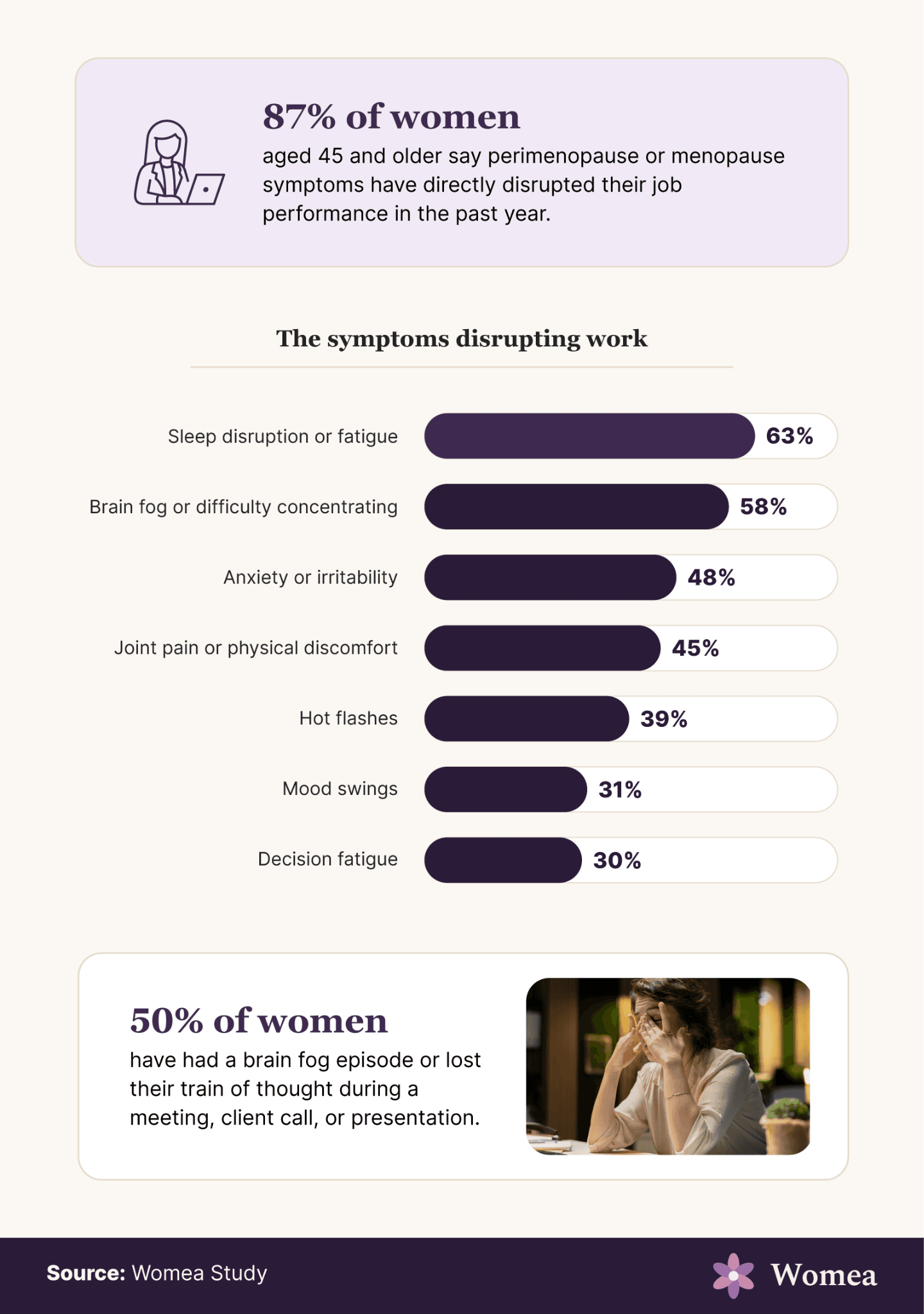
Sleep disruption and fatigue topped the list of culprits, which tracks with how the transition actually works: night sweats and disrupted sleep degrade the next day's focus before any other symptom gets a chance to. Brain fog came second, and anxiety or irritability third.
| Symptom | Share of women |
|---|---|
| Sleep disruption or fatigue | 63% |
| Brain fog or difficulty concentrating | 58% |
| Anxiety or irritability | 48% |
| Joint pain or physical discomfort | 45% |
| Hot flashes | 39% |
| Mood swings | 31% |
| Decision fatigue | 30% |
Half of women (50%) have had a brain fog episode or lost their train of thought in the middle of a meeting, client call, or presentation. More than 1 in 5 (21%) have called out sick or used PTO specifically to manage symptoms, missing an average of 3.6 days of work in the past year.
Which parts of the job get hardest on a symptomatic day?
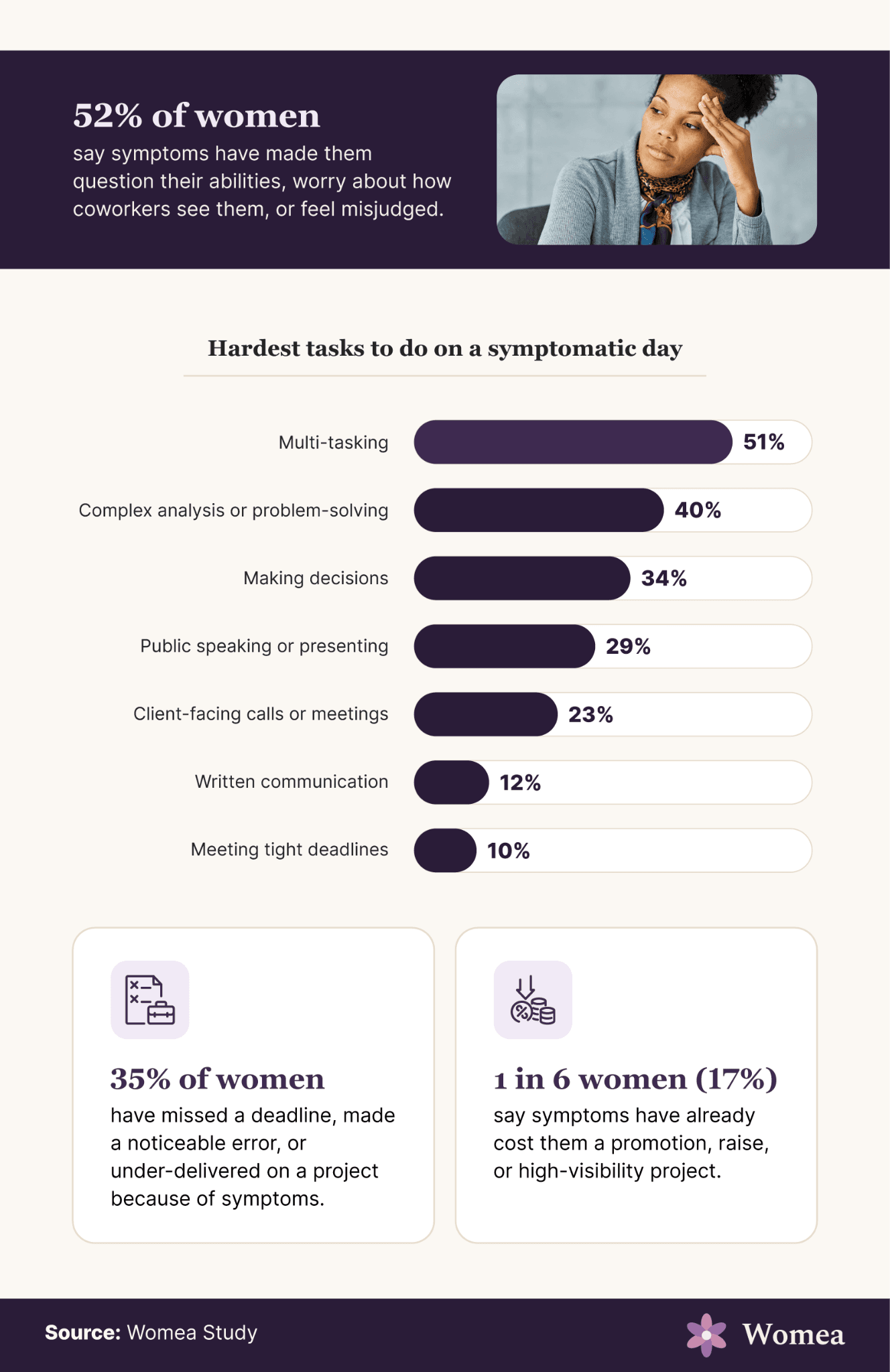
The tasks that suffer most are the cognitively expensive ones. Multi-tasking led at 51%, followed by complex analysis or problem-solving at 40% and decision-making at 34%. Routine written communication and hitting a known deadline were far less affected. In other words, symptoms do not make women bad at their jobs. They tax exactly the kind of thinking that senior work is made of.
| Task | Share of women |
|---|---|
| Multi-tasking | 51% |
| Complex analysis or problem-solving | 40% |
| Making decisions | 34% |
| Public speaking or presenting | 29% |
| Client-facing calls or meetings | 23% |
| Written communication | 12% |
| Meeting tight deadlines | 10% |
Do symptoms make women doubt their own performance?
Yes, and this is where the cost stops being about time. More than half of women (52%) say symptoms have made them question their own abilities, worry about how coworkers see them, or feel misjudged on the job. About 1 in 6 (17%) believe symptoms have already cost them a promotion, a raise, or a high-visibility project, and 35% have missed a deadline, made a noticeable error, or under-delivered on a project as a result.
Some women opt out before symptoms can cost them anything. 12% have turned down a job opportunity they would otherwise have pursued, and about 2 in 5 (38%) have avoided speaking up in a meeting because of brain fog or anxiety. That last number is the quiet one. It does not show up in any performance metric, and it is invisible to everyone except the woman who stayed silent.
| What women reported | Share of women |
|---|---|
| Have avoided speaking up in a meeting because of brain fog or anxiety | 38% |
| Have missed a deadline, made a noticeable error, or under-delivered | 35% |
| Have considered reducing their work hours | 23% |
| Have called out sick or used PTO to manage symptoms | 21% |
| Believe symptoms have cost them a promotion, raise, or key project | 17% |
| Are considering leaving their job in the next 12 months | 14% |
| Have turned down a job opportunity they would otherwise have pursued | 12% |
The toll compounds. Nearly 1 in 4 (23%) have considered reducing their hours, and 14% are considering leaving their job in the next 12 months. These are women in their late forties and fifties, which is to say women at the most experienced and most expensive-to-replace point of their careers.
Why do most women say nothing at work?
Because there is usually nothing to say it to. Nearly 9 in 10 women (89%) say their employer has no formal menopause or midlife health policy. For 3 in 5 (60%), no one at work knows about their symptoms, and 54% said they would not feel safe telling their manager if they were struggling.
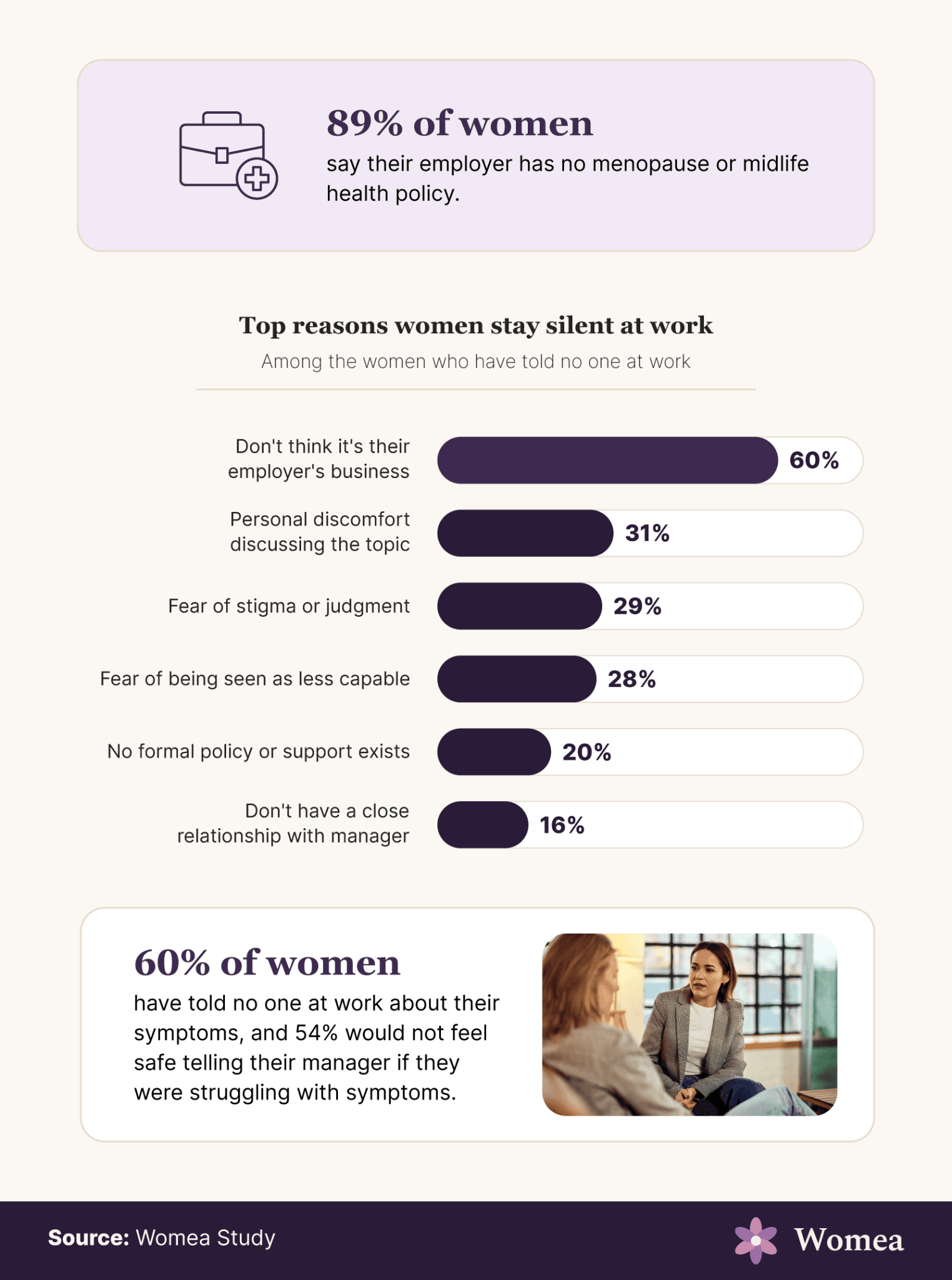
Privacy is the biggest driver of that silence, not shame. Among women who have stayed quiet, 60% simply do not think it is their employer's business. That is a legitimate position, and it is worth separating from the reasons that follow it, which are less freely chosen: personal discomfort, fear of stigma, and fear of being seen as less capable.
| Reason | Share of women |
|---|---|
| Do not think it is their employer's business | 60% |
| Personal discomfort discussing the topic | 31% |
| Fear of stigma or judgment | 29% |
| Fear of being seen as less capable | 28% |
| No formal policy or support exists | 20% |
| Do not have a close relationship with their manager | 16% |
What can you actually do about it?
The symptoms driving these numbers are common, well understood, and treatable. Sleep disruption, hot flashes and night sweats, and brain fog and mood changes all respond to care, and none of them require you to disclose anything to your employer to get treated. You also do not need bloodwork to start the conversation, because menopause is diagnosed from symptoms and history rather than a hormone panel. What each medication costs is published up front, before you talk to anyone.
If you want the full picture before you talk to anyone, our complete guide to hormone therapy for menopause covers what it treats, what the evidence shows, and who it suits. If you are still in the years of change rather than past them, start with the complete guide to perimenopause instead, since that is the stage most of the women in this survey were describing. If you are weighing providers, our side-by-side comparisons lay out price, what each price includes, and where another service fits you better.
- Name the pattern before you name the diagnosis. Two weeks of notes on when symptoms hit, and what they cost you, turns a vague complaint into something a clinician can act on.
- Start with sleep. It was the single biggest disruptor in this survey, and it makes every other symptom on the list worse.
- Do not accept "that is just your age" as a plan. It is a description, not a treatment, and it is the reason a lot of women in this survey waited years.
- If you are unsure what to ask for, how to talk to your clinician about hormone therapy walks through the specific questions worth bringing.
- Brain fog and concentration were the second biggest disruptor here, and estradiol and micronized progesterone are the two medications most of that conversation will be about.
The bottom line
None of this means menopause belongs in a performance review. It means a lot of skilled, experienced women are working around symptoms their employers do not acknowledge, and many are quietly doubting themselves along the way. The symptoms are common and manageable, and they do not say anything about how good you are at your job.
A later Womea survey, of 1,042 people currently experiencing perimenopause or menopause, found the same effort from the other direction: 91% try to hide at least one symptom in public, and 57% feel pressure at work to appear unaffected.
You also do not have to push through on your own. Talking with a clinician who takes midlife health seriously can help you understand what is going on and what your options are, in plain language and without the hard sell. If you want to see the steps before committing to anything, how a visit actually works walks through them. Hormone therapy has both benefits and risks, and whether it is right for you is a decision a licensed clinician makes with you after reviewing your history. If you have been putting yourself last, this is a fair place to start.
Methodology
Womea surveyed 831 employed women aged 45 and older who identified as perimenopausal, menopausal, or post-menopausal, to explore the impact of these transitions in the workplace. The survey was fielded in July 2026. For the time-cost figures, meaning average hours spent managing symptoms per workday and estimated annual workdays lost, the IQR method was used to trim outliers, and annual estimates assume a 261-workday year. The same outlier-trimming method was applied to the average number of sick days or PTO days taken to manage symptoms.
These are self-reported figures from women describing their own experience, not clinical measurements of job performance, and they describe association rather than proving that symptoms caused a specific career outcome.
Fair use
These findings are free to cite with attribution to Womea and a link back to this page, and the research is available for noncommercial reuse on the same terms. A full data table sits under every chart above, and all of them are downloadable as CSV: perimenopause-productivity-gap.csv. Journalists and researchers with other questions can reach us at care@womea.com.
Questions, answered
About one hour per workday. In a Womea survey of 831 employed women aged 45 and older, the average respondent spent roughly an hour of each workday managing perimenopause or menopause symptoms instead of doing her job, which works out to about 276 hours or 34.5 workdays a year.
Explore the related treatments
If this is relevant to you, these are the treatments it most often connects to.
Sleep disruption
Menopause disrupts sleep through night sweats, anxiety, and falling progesterone. Treating the hormonal cause restores rest in a way sleep aids cannot.
See the treatmentMood & brain fog
Brain fog, irritability, and low mood are real, hormone-driven symptoms of the menopause transition, not personal failings.
See the treatmentHot flashes & night sweats
Hot flashes and night sweats are the most common and most treatable symptoms of menopause. Hormone therapy is the most effective treatment available.
See the treatmentMore from the blog
Women quietly adapt to menopause in ways most people never notice
Most women in perimenopause or menopause are managing symptoms so that no one notices. We surveyed 1,042 women about what they hide, where they hide it, and what it costs them. Here is the playbook they rarely talk about.
9 min readWhat to expect in your first 90 days of HRT
Starting hormone therapy is a process, not a switch. Here is an honest timeline of the first three months — what often improves early, what takes longer, and how dose adjustments work.
6 min readWhy menopause does not require blood tests to treat
Many women are told they need hormone bloodwork before they can be treated. For most, that is not true. Menopause is a clinical diagnosis, and treatment is guided by how you feel.
5 min readThese symptoms are treatable.
Take the 3-minute assessment, then meet a US-licensed clinician by video or phone who reviews your history before prescribing.
Free shipping · Cancel anytime · HSA / FSA eligible · No membership fee