Women quietly adapt to menopause in ways most people never notice
Most women in perimenopause or menopause are managing symptoms so that no one notices. We surveyed 1,042 women about what they hide, where they hide it, and what it costs them. Here is the playbook they rarely talk about.

Most women in perimenopause or menopause are managing symptoms so that nobody notices. In a Womea survey of 1,042 people experiencing perimenopause or menopause, 91% said they try to hide at least one symptom in public, and 57% said they feel pressure at work to seem unaffected. If you have ever timed a break around a hot flash, you already know the routine.
Perimenopause and menopause symptoms do not wait for a convenient moment. They show up in meetings, at dinners, and in the middle of a family gathering, and most women have built a set of habits to keep them out of view. We asked more than 1,000 women to describe those habits.
Which menopause symptoms do women hide in public?
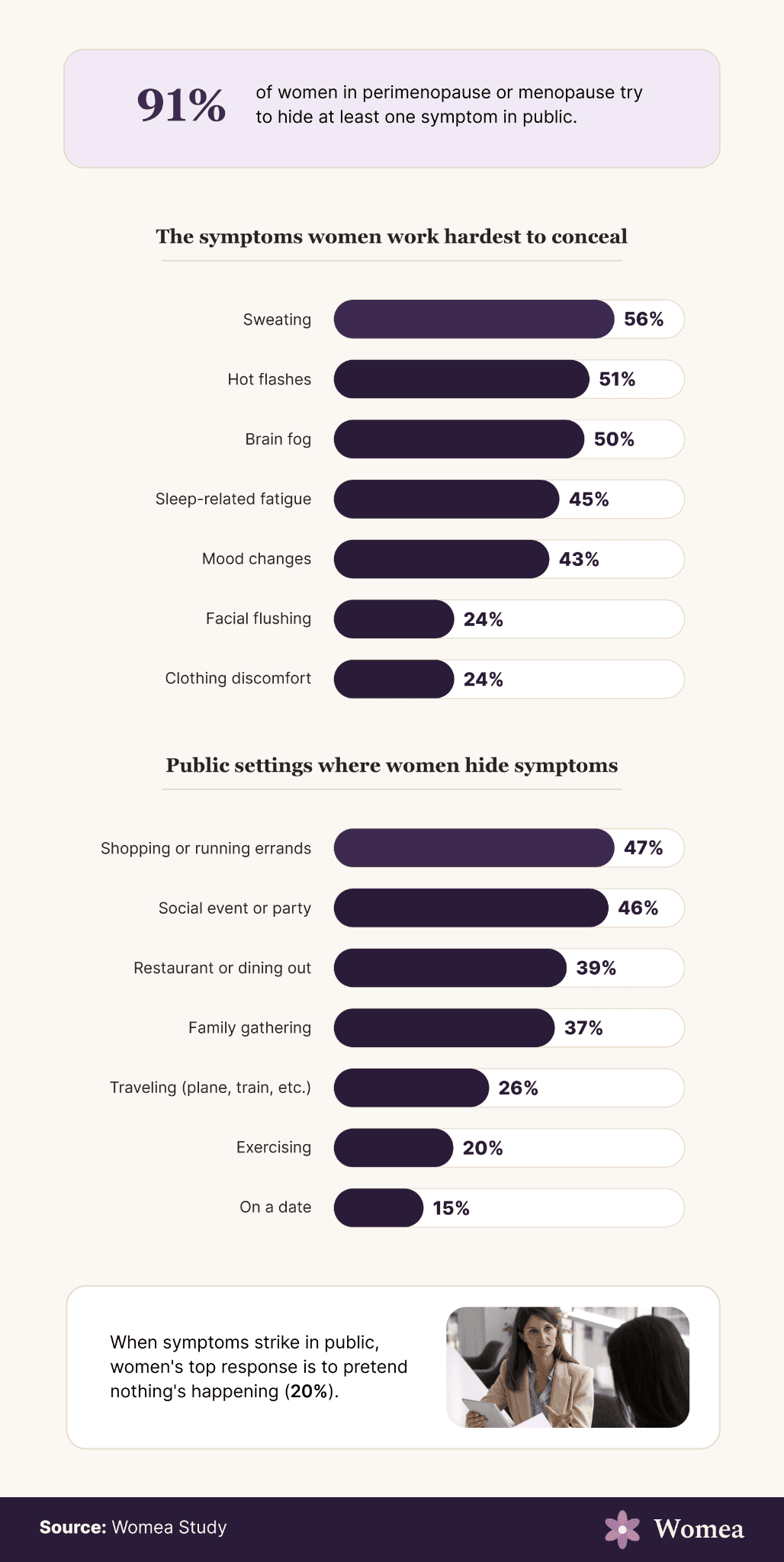
Sweating is the symptom women work hardest to conceal, named by 56%. Hot flashes follow at 51% and brain fog at 50%. The most common response when a symptom arrives in public is simply to pretend nothing is happening, chosen by 20%. Only about 1 in 5 (19%) say they would openly acknowledge it.
| Symptom | Share of women |
|---|---|
| Sweating | 56% |
| Hot flashes | 51% |
| Brain fog | 50% |
| Sleep-related fatigue | 45% |
| Mood changes | 43% |
| Facial flushing | 24% |
| Clothing discomfort | 24% |
Where it happens shows how constant the effort is. Shopping or running errands leads at 47%, nearly tied with social events at 46%. Symptoms are concealed about equally often at restaurants (39%) and family gatherings (37%). One generational gap stands out: millennial women are more than twice as likely as baby boomers to hide symptoms while shopping, 53% against 25%.
| Setting | Share of women |
|---|---|
| Shopping or running errands | 47% |
| Social event or party | 46% |
| Restaurant or dining out | 39% |
| Family gathering | 37% |
| Traveling (plane, train, etc.) | 26% |
| Exercising | 20% |
| On a date | 15% |
How does menopause affect women at work?
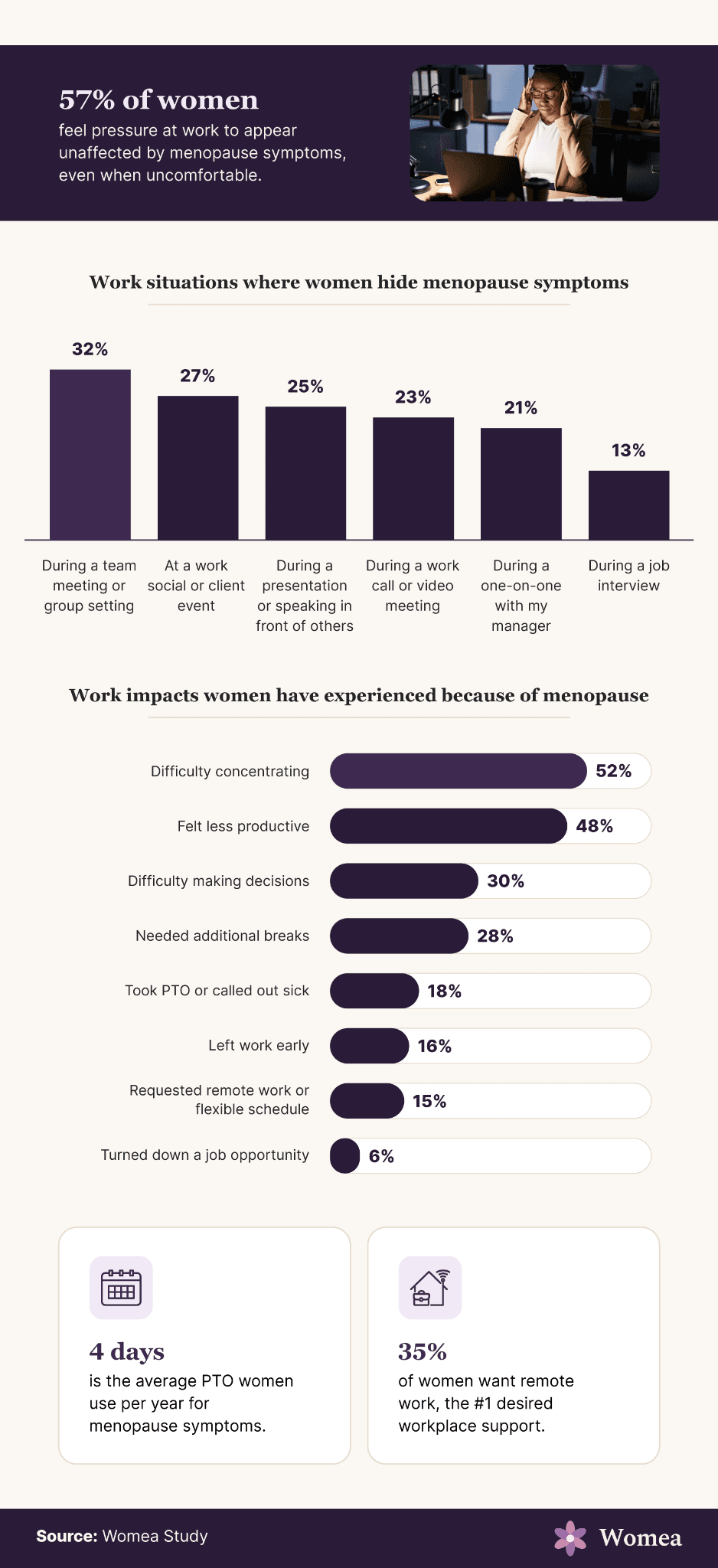
The hardest moments are the visible, high-stakes ones. Team meetings lead at 32%, followed by work socials or client events at 27% and presentations at 25%. Nearly 3 in 5 women (57%) say they feel pressure to appear unaffected, and 43% worry that visible symptoms make them look less professional.
| Work situation | Share of women |
|---|---|
| During a team meeting or group setting | 32% |
| At a work social or client event | 27% |
| During a presentation or speaking in front of others | 25% |
| During a work call or video meeting | 23% |
| During a one-on-one with my manager | 21% |
| During a job interview | 13% |
The impacts are the kind that shape a career rather than just a difficult afternoon. Nearly 1 in 5 women (18%) have taken PTO or called out sick because of symptoms, averaging about 4 workdays a year.
| Impact | Share of women |
|---|---|
| Difficulty concentrating | 52% |
| Felt less productive | 48% |
| Difficulty making decisions | 30% |
| Needed additional breaks | 28% |
| Took PTO or called out sick | 18% |
| Left work early | 16% |
| Requested remote work or a flexible schedule | 15% |
| Turned down a job opportunity | 6% |
Only about 1 in 3 women (34%) feel their coworkers and manager truly understand what they are experiencing. Asked what would help, they named practical fixes rather than sympathy: remote work (35%), better temperature control (34%), and a flexible schedule (26%). Even among senior managers and executives, 90% want at least one form of workplace support.
| Workplace support | Share of women |
|---|---|
| Remote work | 35% |
| Better temperature control | 34% |
| Flexible schedule | 26% |
How does menopause change what women wear and do every day?
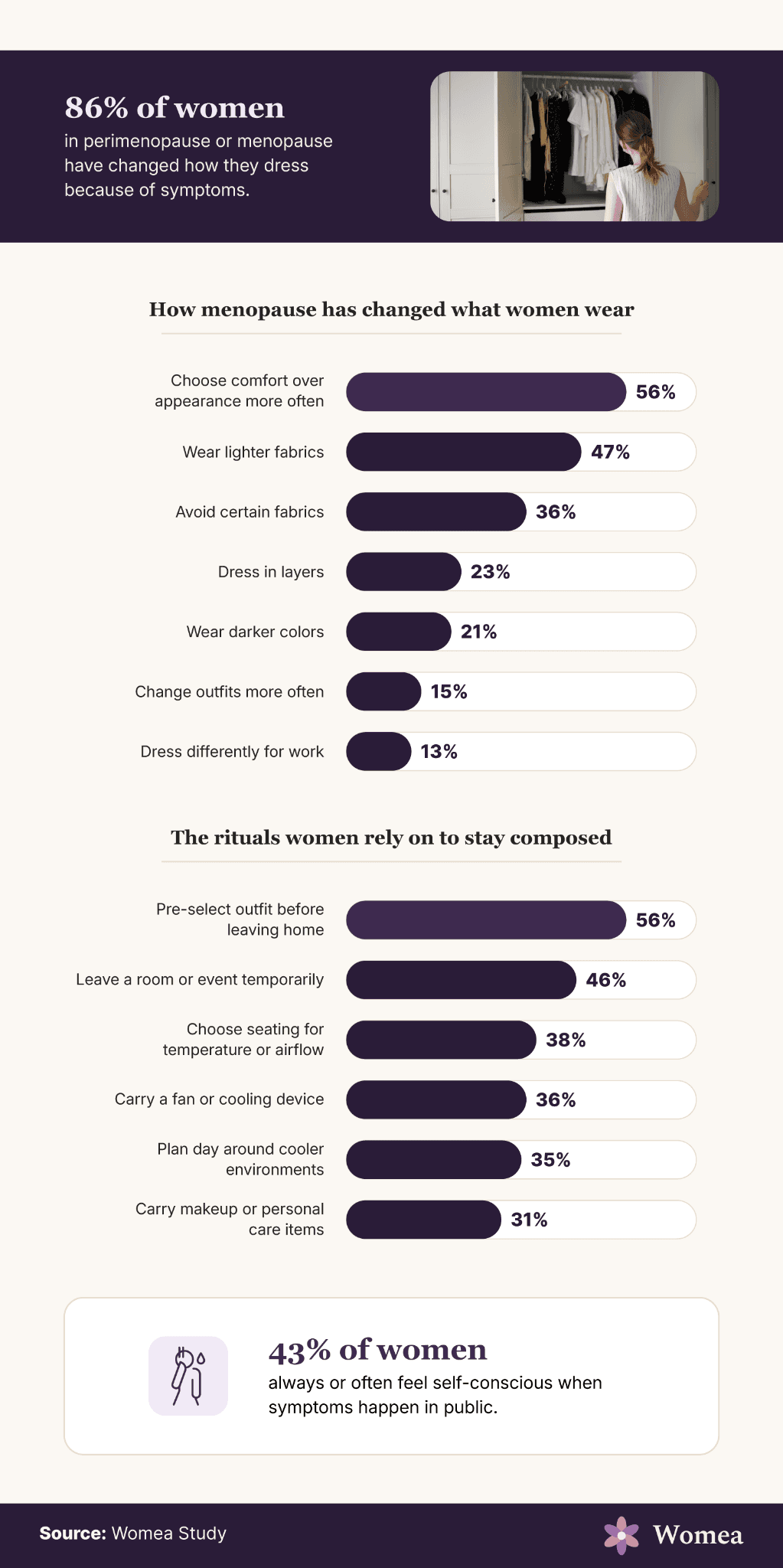
More than 8 in 10 women say symptoms have changed how they dress, and 13% now dress differently for work specifically. Comfort wins more often than it used to, chosen over appearance by 56%, and nearly half (47%) have switched to lighter fabrics.
| Change | Share of women |
|---|---|
| Choose comfort over appearance more often | 56% |
| Wear lighter fabrics | 47% |
| Avoid certain fabrics | 36% |
| Dress in layers | 23% |
| Wear darker colors | 21% |
| Change outfits more often | 15% |
| Dress differently for work | 13% |
Beyond clothing, women rely on specific habits to stay composed. More than half (56%) pre-select an outfit before leaving home, 46% step out of rooms to manage symptoms, and 36% carry a fan. Temperature often runs the day, with 38% choosing seats for airflow and 35% planning around cooler spaces.
| Ritual | Share of women |
|---|---|
| Pre-selected an outfit before leaving home | 56% |
| Left a room or event temporarily | 46% |
| Chose seating for temperature or airflow | 38% |
| Carried a fan or cooling device | 36% |
| Planned the day around cooler environments | 35% |
| Carried makeup or personal care items | 31% |
Underneath the effort is an emotional cost. When symptoms happen in public, 43% of women usually feel self-conscious, 42% report frustration and 37% report anxiety. Millennial women feel it most sharply: 46% report anxiety about symptoms often or always, more than double the 21% among baby boomers.
| Emotional response | Share of women |
|---|---|
| Self-conscious | 43% |
| Frustration | 42% |
| Anxiety | 37% |
What can you actually do about it?
A few small shifts lower the daily effort of handling these symptoms. Here is where the women in this survey pointed, and what tends to move the needle. The symptoms women named most often are the ones care is aimed at: sweating and hot flashes at 56% and 51%, and brain fog at 50%.
- Ask for the fix, not the sympathy. The supports women rated highest were plain logistics: remote days, a cooler workspace, a flexible schedule. You can request those without ever naming a symptom.
- Aim for better sleep before anything else. It was the disruptor most likely to drag the rest of the list down with it, so it is usually the highest-leverage place to spend your energy. Menopause sleep problems covers what actually helps, and sleep support covers what a clinician can prescribe for it.
- Write down the pattern for two weeks. Note when symptoms hit and what they interrupted. It gives a clinician something concrete to respond to.
- Skip the bloodwork gate. Menopause is diagnosed from symptoms and history rather than a hormone panel, so a stalled request for lab tests does not have to hold up the conversation.
- If you want the full picture first, the complete guide to hormone therapy for menopause covers what it treats and who it suits, and the complete guide to perimenopause covers the stage most women in this survey were in.
The bottom line
Keeping your composure through menopause symptoms is real work, and none of the hiding says anything about how good these women are at their jobs. Our earlier survey found the same pattern from the other direction: symptoms cost the average working woman about an hour of every workday, and most of that is invisible too.
The symptoms behind all this effort are common and manageable, and you do not have to manage them alone. Here is how a visit works. Hormone therapy has both benefits and risks, and whether it fits you is a decision a licensed clinician makes with you after reviewing your history.
Methodology
Womea surveyed 1,042 women and nonbinary individuals currently experiencing perimenopause or menopause, to understand the social strategies used to manage symptoms in public and at work. The survey examined which symptoms women work hardest to conceal, the settings where they feel the greatest pressure to stay composed, the tactics and rituals they rely on away from home, and the emotional and professional costs of maintaining that composure.
The average respondent age was 48. Gen X made up the largest share at 57%, followed by millennials (35%), baby boomers (7%) and Gen Z (1%). All respondents were assigned female at birth; 99% identify as women and 1% as nonbinary. Just over 3 in 5 (61%) were currently experiencing perimenopause, 33% were currently experiencing menopause symptoms, and 7% had gone through menopause but were no longer experiencing symptoms. Most respondents were employed (80%). The survey was conducted online in July 2026.
These are self-reported figures from people describing their own experience, not clinical measurements, and they describe association rather than proving that symptoms caused any specific outcome.
Fair use
These findings are free to cite with attribution to Womea and a link back to this page, and the research is available for noncommercial reuse on the same terms. A full data table sits under every chart above, and all of them are downloadable as CSV: menopause-in-public.csv. Journalists and researchers with other questions can reach us at care@womea.com.
Questions, answered
In a Womea survey of 1,042 women, 91% said they try to hide at least one symptom in public. Sweating (56%), hot flashes (51%) and brain fog (50%) were hardest to conceal, and the most common response was to pretend nothing was happening (20%).
Explore the related treatments
If this is relevant to you, these are the treatments it most often connects to.
Hot flashes & night sweats
Hot flashes and night sweats are the most common and most treatable symptoms of menopause. Hormone therapy is the most effective treatment available.
See the treatmentMood & brain fog
Brain fog, irritability, and low mood are real, hormone-driven symptoms of the menopause transition, not personal failings.
See the treatmentSleep disruption
Menopause disrupts sleep through night sweats, anxiety, and falling progesterone. Treating the hormonal cause restores rest in a way sleep aids cannot.
See the treatmentMore research and reading
The perimenopause productivity gap: how symptoms cost women at work
Perimenopause and menopause symptoms do not stay home when you go to work. We surveyed 831 employed women aged 45 and older about what happens in meetings, on client calls, and in performance reviews. Here is what they told us.
8 min readWhat to expect in your first 90 days of HRT
Starting hormone therapy is a process, not a switch. Here is an honest timeline of the first three months — what often improves early, what takes longer, and how dose adjustments work.
6 min readWhy menopause does not require blood tests to treat
Many women are told they need hormone bloodwork before they can be treated. For most, that is not true. Menopause is a clinical diagnosis, and treatment is guided by how you feel.
5 min readThese symptoms are treatable.
Take the 3-minute assessment, then meet a US-licensed clinician by video or phone who reviews your history before prescribing.
Free shipping · Cancel anytime · HSA / FSA eligible · No membership fee